
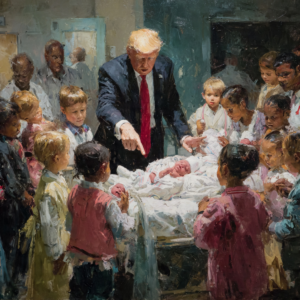
 President Trump is attacking the very foundation of U.S. immigration law and our legal system in general by trying to revoke birthright citizenship. Here is why this is such a dangerous slippery slope we are treading on right now:
Why Undermining Birthright Citizenship Threatens the U.S. Legal System and Democratic Foundations
Almost every American has a family story rooted in immigration—a story of arrival, resilience, and the pursuit of opportunity. While the United States has a deeply complex and often painful history—including the displacement of Indigenous peoples, slavery, and war—it has also stood for over 150 years on one foundational promise: that anyone born on U.S. soil, with narrow exceptions, is a citizen. This principle, known as birthright citizenship, is a bedrock of equality, legal clarity, and constitutional order. Eroding it would not only destabilize our legal system but also open the door to dangerous executive overreach.
What Is Birthright Citizenship?
Birthright citizenship, or jus soli, is the legal doctrine that grants citizenship to anyone born within a country’s territory. In the U.S., this right is enshrined in the Fourteenth Amendment to the Constitution, ratified in 1868 in direct response to the Dred Scott decision, which had denied citizenship to Black Americans. The amendment guarantees citizenship to “all persons born or naturalized in the United States, and subject to the jurisdiction thereof.” Courts have consistently interpreted this to mean nearly all individuals born on U.S. soil, regardless of their parents’ immigration status.
In contrast, many countries follow jus sanguinis (citizenship by descent), or a conditional jus soli model, which limits citizenship at birth based on parental nationality or legal status. The U.S. chose a different path—one designed to unify a diverse population, integrate newcomers, and prevent the creation of a stateless underclass.
Legal Precedent Is Clear
The Supreme Court affirmed this principle in United States v. Wong Kim Ark (1898), holding that the U.S.-born child of Chinese immigrants was a U.S. citizen. That decision has remained unshaken for over a century. More recently, courts reaffirmed this right even in the face of political challenges. In 2025, when President Trump issued Executive Order 14160 to deny citizenship to U.S.-born children of undocumented and temporary-status immigrants, federal courts swiftly blocked it, citing constitutional protections that cannot be undone by executive fiat.
Only a constitutional amendment—or a radical, unprecedented reversal by the Supreme Court—could lawfully undo birthright citizenship. The legal and procedural hurdles to such a change are intentionally high.
The Risks of Making Citizenship Conditional
Altering birthright citizenship would fundamentally destabilize our legal system. First, it would create bureaucratic chaos: every birth would require proof of parental legal status, placing immense pressure on hospitals, vital records offices, and immigration agencies. The result would be more stateless children—unable to prove citizenship anywhere—and more inequality baked into the system from birth.
Second, it would expand executive power in troubling ways. Allowing the president—or even Congress—to unilaterally redefine who is and isn’t a citizen undermines the separation of powers and the rule of law. If citizenship becomes a privilege granted at the government’s discretion, rather than a right guaranteed by the Constitution, it could open the door to politically motivated denials of citizenship and systemic disenfranchisement.
A Threat to American Identity
More than a legal concept, birthright citizenship is a defining element of what it means to be American. It has ensured that the children of immigrants—whether their parents arrived with documents or without—are fully part of the American fabric. It avoids the creation of second-class residents. It embodies our national ideals of equality and opportunity.
Critics argue that birthright citizenship encourages undocumented immigration, but evidence does not support this. U.S.-born children of undocumented immigrants do not provide a pathway to legal status for their parents, and immigrants, broadly speaking, contribute more to public coffers than they take in benefits.
Conclusion
Changing birthright citizenship would do more than deny legal status to some children born on U.S. soil—it would shake the very foundations of constitutional law, invite executive abuse, and dismantle a key pillar of American democracy. In a time of political uncertainty, birthright citizenship remains a stabilizing force, protecting the rights of the most vulnerable and reaffirming our national commitment to equality under the law.
The promise of citizenship by birth is not just a policy choice; it’s a constitutional guarantee and a moral commitment. To undo it would not just be legally dubious—it would be un-American.